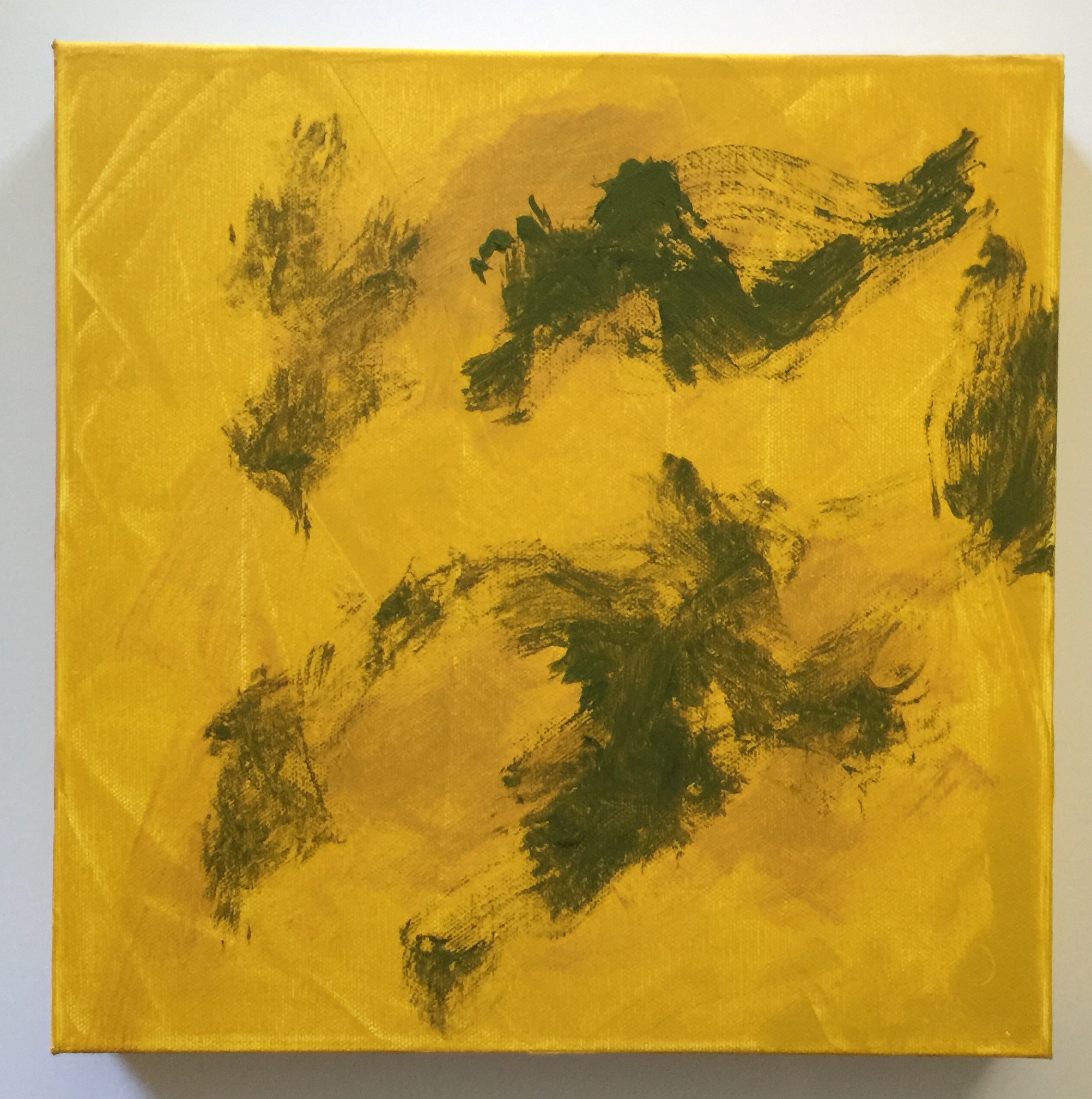
I don’t have a title for this painting. I don’t really like titles for paintings mainly because they reinforce the idea that a painting is about some “thing” outside itself and the process of its making.
The process of making this painting involved choosing the substrate, a pre-primed commercial canvas 12″ x 12″ x 2″, a size that I like working with and which fits comfortably on my small work table in my small studio. Almost at the same time that I was choosing the canvas I was also deciding on the palette. I knew I wanted a base layer of yellow (Turner’s Yellow, I decided) with an overlay of another shade of yellow (Yellow Oxide). Then I decided on a green for the calligraphic marks that I envisioned making. This green was made by using the base yellow mixed with a bit of ivory black (because it has a blue base to help yellow become green).
I applied the Turner’s Yellow with a medium-sized plastic scraper that I bought at Home Depot, making some gestural marks in the process. After this layer dried, I used a smaller scraper to apply the Yellow Oxide in gestural spreads to create zones in the canvas. These zones then became the markers for the application of the green using a long-handled Chinese brush for its calligraphic effects. I wanted to draw on my experience of learning Chinese calligraphy (learning by no means thoroughly!) to create a calligraphic effect in the work.
Nearly all of my painting is non-objective, i.e. abstract, not about concrete things in the world but about form and color and texture and gesture. All of my work is exploratory in nature, i.e. process-oriented and finding its way bit by bit.
Although my description above sounds as though I pre-planned this painting in a methodical way, I must note that this description is written after the fact of making the painting. What really happened was more like this: I had one 12″ x 12″ canvas at hand, and I got the feeling that it wanted me to put down a yellow base layer on it and do it in some texturally or gesturally interesting way. So I reached for a scraper rather than a brush or brayer for this.
As the paint was drying, I felt that the canvas was calling for some spontaneous non-geometrical “zoning” with some other color that would not be too intrusive. Thus, the yellow base seemed to call for another shade of its own color and the use of a smaller scraper.
When that stage of the work had dried and I looked at the canvas again, it seemed to be asking me to pull out of myself some calligraphic gestures using a Chinese brush that had been resting in a yogurt cup on the floor below my table for some time. The brush itself seemed to dictate the gestures I made in wielding it over the canvas, calling out of me something of my own experience with calligraphic brushwork in the past. This stage of the work was a kind of simultaneous writing and painting. I don’t know what the Chinese words might be that my brushstrokes created, but I felt that I was “writing” something that might be “read.”
This painting, in its completion, represents the mark of an interaction between the materials and me. While it might be said that I created the painting, and most viewers would probably have to think that way, this does not represent my experience of the process, which is quite the opposite: that, in fact, the painting created me — or the “me” that was active in the painting’s process of creating itself.
The self that I am aware of in the face of the completed painting is not a self that pre-existed the making of the painting but rather a self that has arisen as a result of making the painting. In a real sense, the painting created me, or at least this me. Another painting will (and has) created another me. My perception of who I am is different now after having experienced the making of this painting.
 Thousand Word Studio